
 New
Lieflat: Less AI Tone
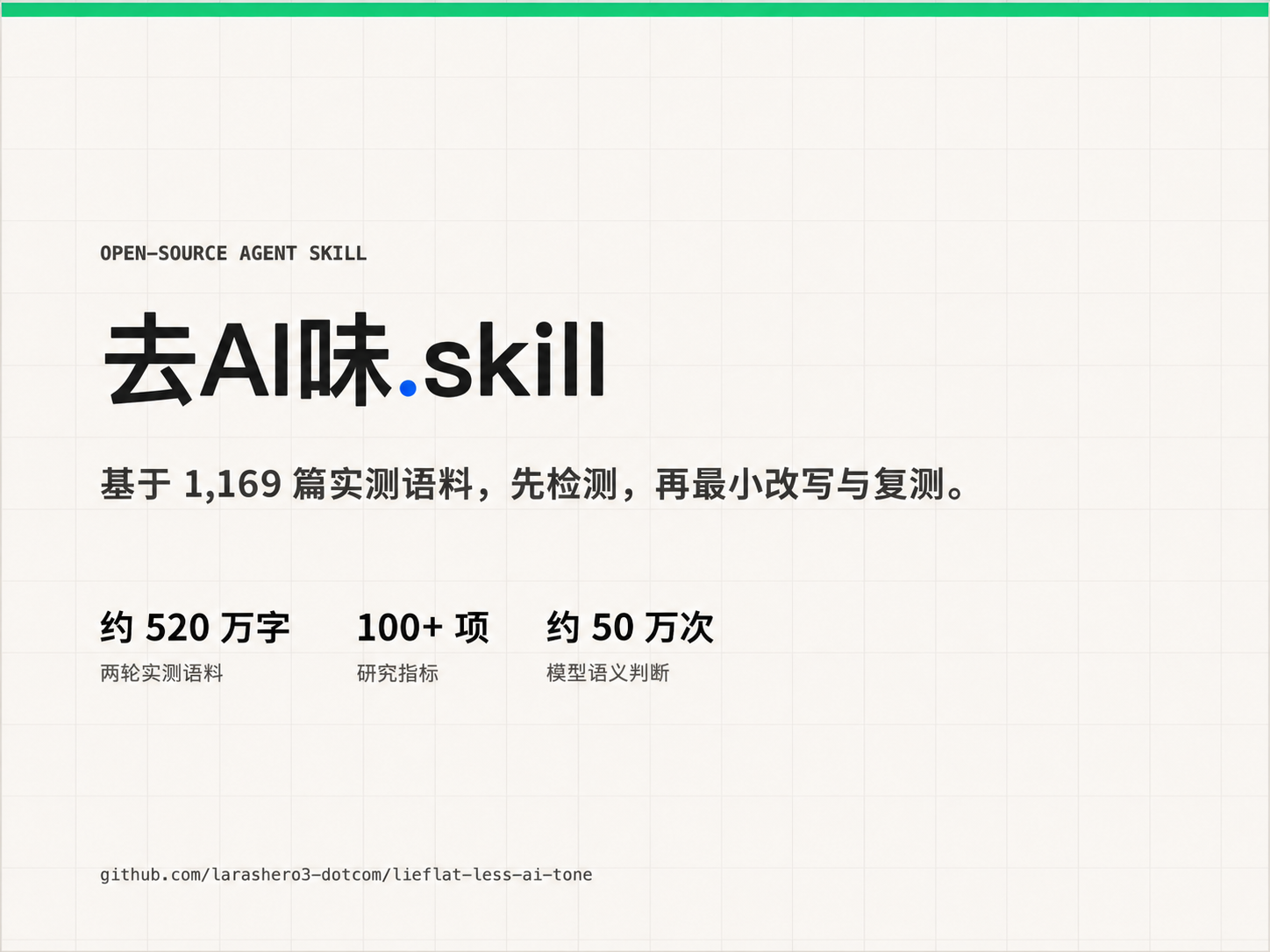
A Chinese-language editing skill that removes AI writing tells, built on a corpus study that used Jev for roughly 500,000 semantic judgments.
Added to Jevfast
NewA Chinese-language editing skill that removes AI writing tells, built on a corpus study that used Jev for roughly 500,000 semantic judgments.
The corpus study behind the skill used Jev for its semantic layer: passage-level candidates were turned into closed label questions, such as how many times a paragraph renames one entity, whether an adjacent sentence pair is merely continued or jumps, and whether a colon announces a conclusion. The study reports about 500,000 such judgments across its two rounds, and the skill's published runtime does script checks plus session-model review.
How many times does the paragraph rename one entity or concept with a different content word instead of repeating the same name?
The study's semantic layer gives each candidate one closed label from the criteria file: a paragraph for the renaming count, a sentence pair for the transition type, a colon sentence for its category, or a three-sentence group for structural repetition. The chart shows the renaming question, the strongest signal in the study.
A local script counts punctuation, sentence lengths and section shapes, and grades each hit for the report.
The script exports paragraphs, sentence pairs, colon sentences and three-sentence groups for the semantic layer.
Each candidate is given one closed label from the criteria file, with a confidence and a one-line reason.
The skill delivers the measured counts, examples and proposed edits, and waits for the writer's reply.
After approval it applies the agreed edits, reruns the checks and produces a before-and-after report.
It measures AI writing tells against 629 human-written controls and a paired retest, then drops rules that the retest contradicted instead of keeping a longer checklist. The paper trail keeps raw hit counts and per-item labels so a claim can be recounted.