
Jevstiller
A proxy that distills Jev's repeated classifications into a small local model and keeps sending the uncertain remainder back to Jev.
Added to Jevfast
A proxy that distills Jev's repeated classifications into a small local model and keeps sending the uncertain remainder back to Jev.
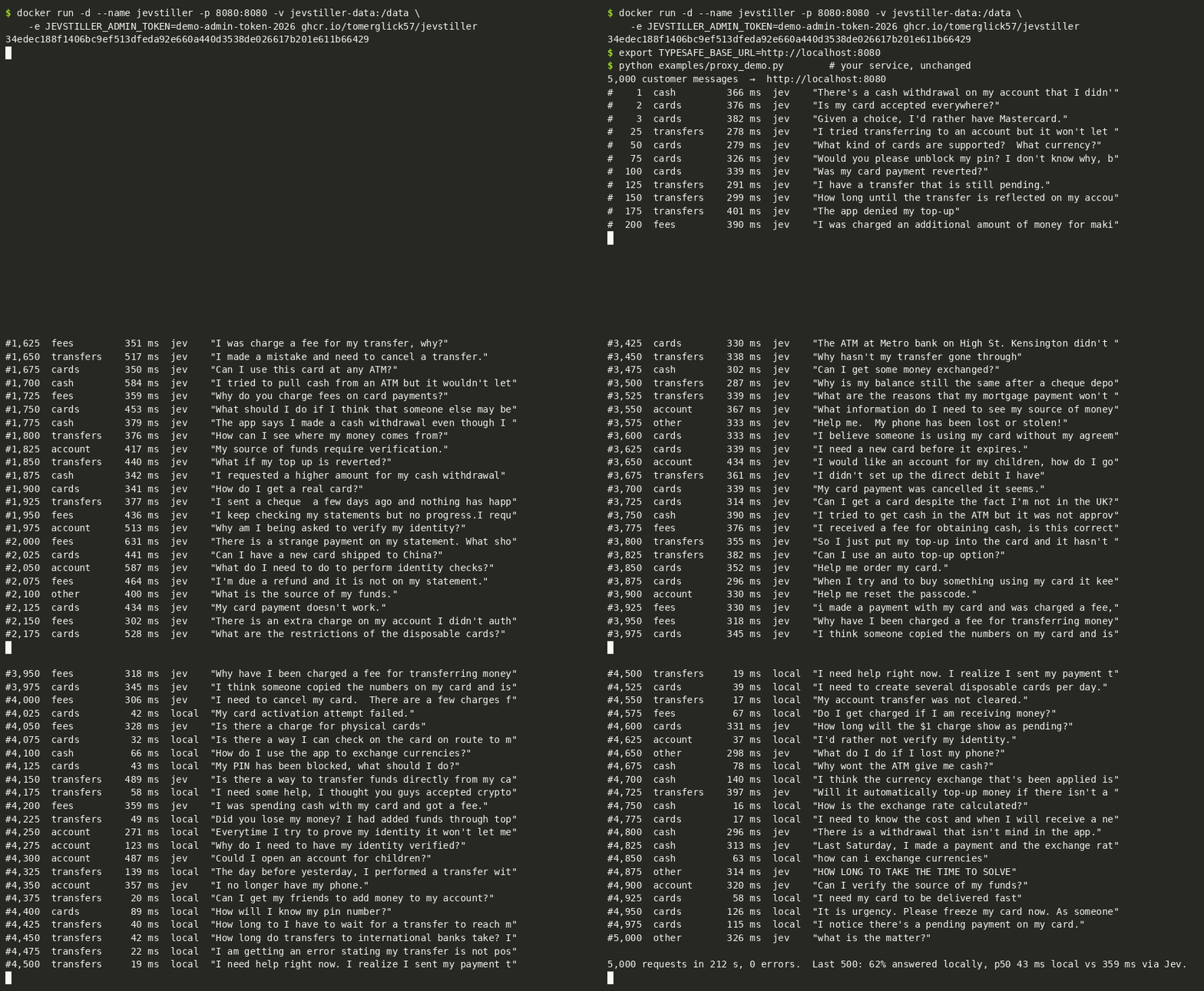
The proxy forwards the first classifications unchanged and keeps Jev's answers with their full probability distributions. From that traffic it trains a small local student, checks the student against Jev within the disagreement budget the operator sets, and answers the requests it is confident about locally while uncertain or novel input and a permanent random audit slice still reach Jev.
Which Banking77 support intent does this customer message belong to?
The state is one customer message, and the question is the fixed intent list the calling app already asks Jev about. Banking77 supplies 77 intents; five are shown here, with the selected answer standing for the label Jev returned.
The proxy sits in front of the existing classification call, so the calling app keeps its request and response shape.
Every answer Jev returns is stored with its probability distribution and used to train a small local student model.
The student is evaluated against Jev on held-out traffic and only serves requests while it stays inside the disagreement budget.
Confident, familiar input is answered locally; uncertain or novel input and a permanent random audit slice still go to Jev.
The operator reads how much traffic the student answered and how often it agreed with Jev, against the budget they set.
The agreement target is the contract rather than a claim of equal accuracy: the operator names the share of requests that must still receive Jev's answer, and the published replay reports 70.7% of held-out messages answered locally at 99.45% agreement with Jev against a 98% target.