
JevLoop
An agent harness that answers every fork in its loop with a typed decision and calls the language model only to write.
Added to Jevfast
An agent harness that answers every fork in its loop with a typed decision and calls the language model only to write.
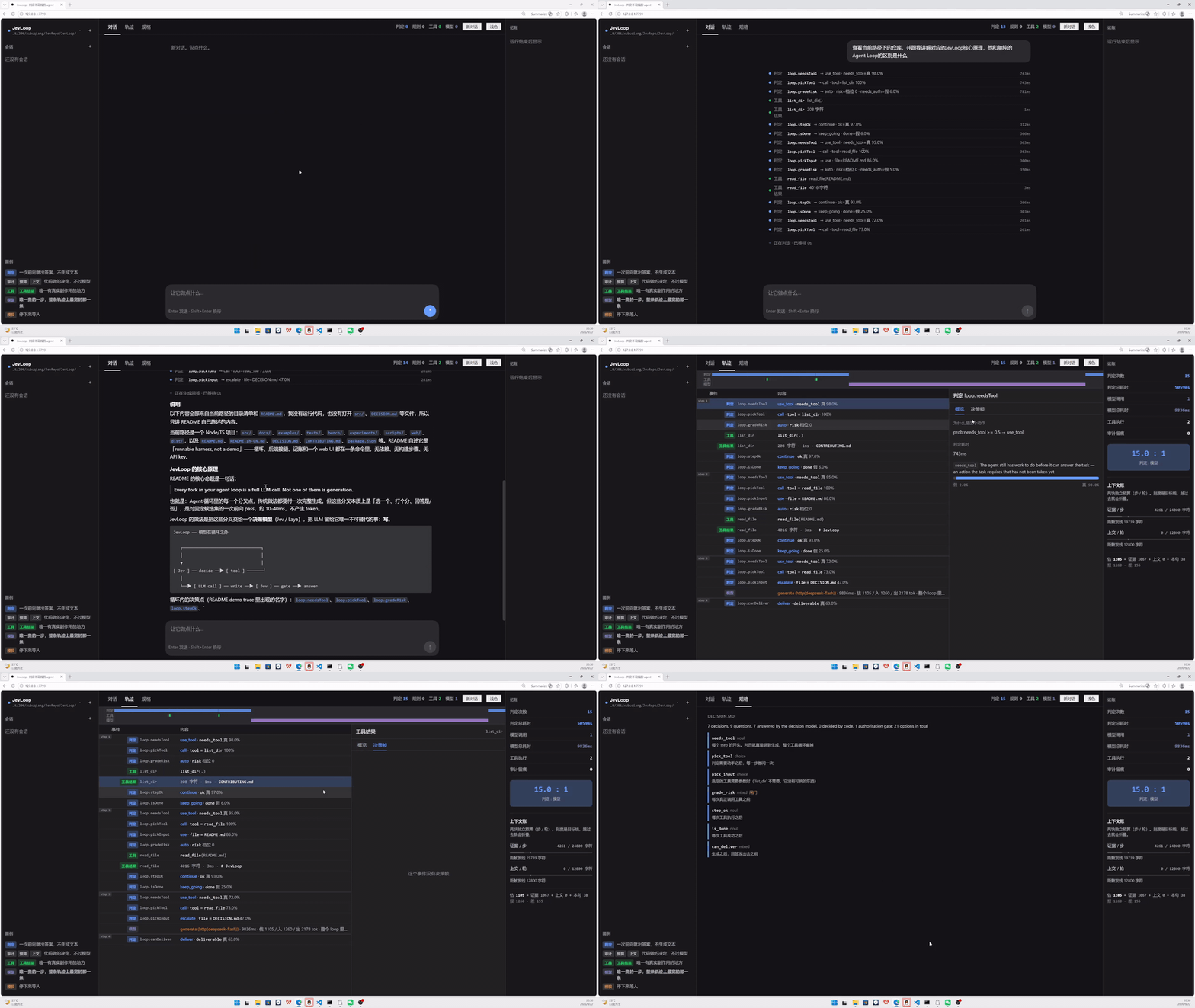
The task text, the allowed tools and the recent steps form the state. Each step asks typed questions declared in DECISION.md: a Noul for whether a tool is needed, a Choice over the available tools for which one, a question on risk, a Noul for whether the step worked, and a Noul for whether the loop is done. The chosen action is executed against the workspace, and one more decision gates the drafted answer before delivery.
Does answering this task need a tool call now, or can the loop move to writing?
The state carries the task text, the permitted tool list and the steps already taken in this run. Two of the per-step questions are shown; the loop also asks about risk, whether the step worked and whether it is done.
Which of the permitted tools should handle this step?
The state carries the task text, the permitted tool list and the steps already taken in this run. Two of the per-step questions are shown; the loop also asks about risk, whether the step worked and whether it is done.
The run uses the hosted Jev API when TYPESAFE_API_KEY is set, otherwise a local Laya sidecar; with neither it reports the missing backend and escalates every step instead of guessing.
DECISION.md declares which questions the loop asks, and the spec command compiles that declaration into the requests the decision model receives.
Each step asks whether a tool is needed and which one, runs the permitted call, then asks whether it worked and whether the loop is done.
The language model is called once to write the answer, and only its draft enters the delivery gate.
A final decision decides whether the draft can ship; a rejected draft gets at most one revision before the run ends.
It removes the language model from the loop's control flow: twelve decisions and one generation in the demo run, with the questions compiled from a file instead of written into a prompt, and a backend chain that falls from hosted Jev to a local Laya sidecar to a rule table while flagging the degraded answers.